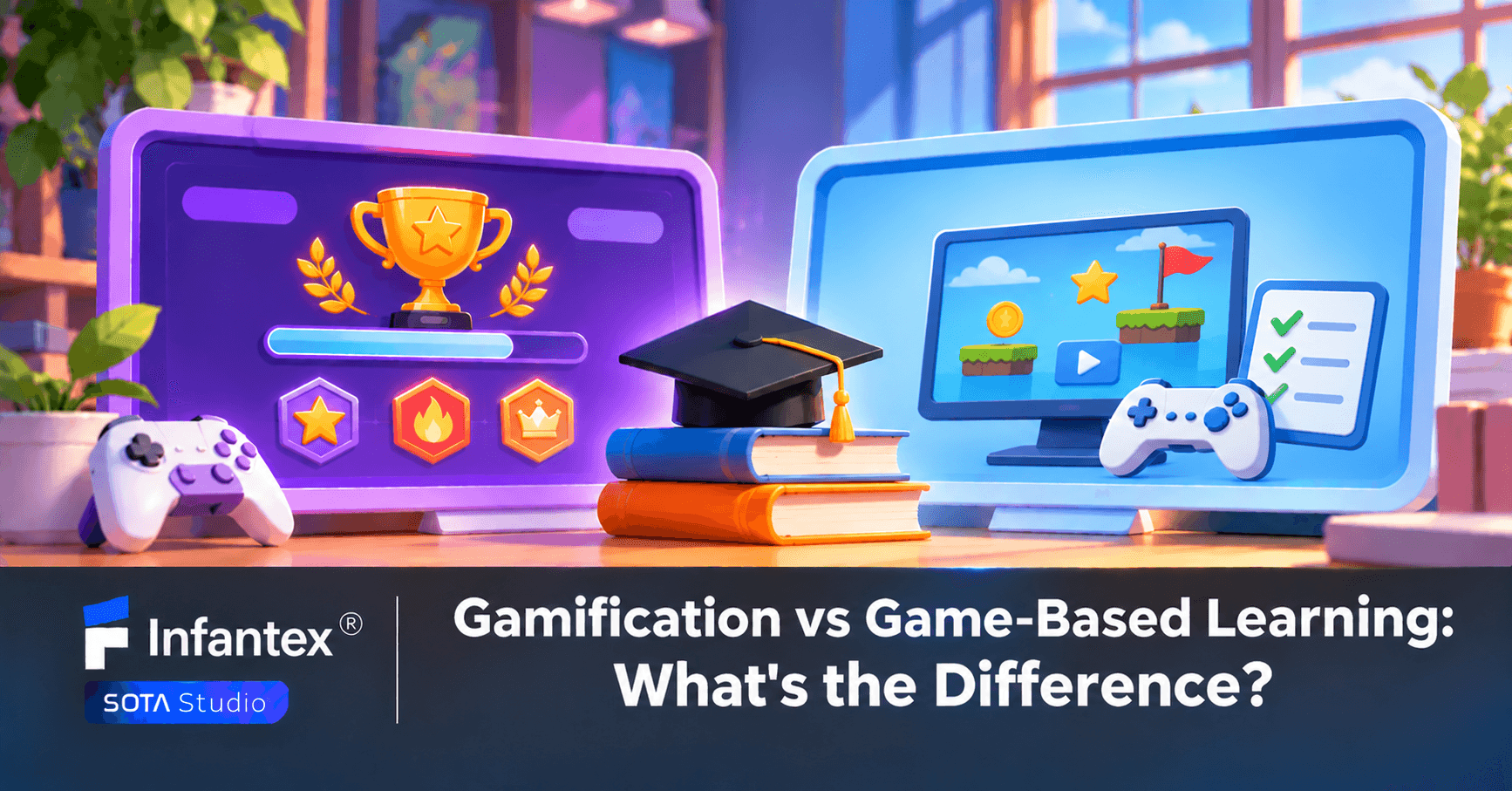
Gamification vs Game-Based Learning: What's the Difference?
Keeping learners engaged has become a major challenge in modern education and corporate training. Traditional learning methods do not always provide enough interaction to maintain attention or encourage active participation. As digital education continues to evolve, organizations are looking for new ways to make learning more engaging and effective.
Two approaches that have gained significant attention are gamification and game-based learning. So, what is the difference between gamification vs game-based learning? How do they work, and which approach is better for your learning objectives? This guide explains their key differences, practical applications, and how businesses can use them to create more engaging learning
What Is Gamification?
Gamification is the process of applying game design elements and mechanics to non-game environments. In education, it introduces features commonly found in games, such as points, badges, leaderboards, challenges, and rewards, into traditional learning activities. The purpose is to make learning more interactive and motivating without turning the entire experience into a game.
Gamification uses familiar game mechanics to create a sense of achievement and progression. Instead of simply completing lessons or assignments, learners receive feedback and recognition as they move through the learning process. Points and rewards encourage participation, while leaderboards introduce a competitive element. Challenges give learners short-term goals, and achievement systems recognize their progress.
However, effective gamification involves more than adding rewards to educational content. Game mechanics need to align with learning objectives and provide meaningful value to the user. When designed properly, gamification can encourage consistent participation, improve motivation, and make digital learning more engaging.
What Is Game-Based Learning?
Game-based learning is an educational approach that uses games to deliver knowledge and develop skills. Unlike gamification, which adds game mechanics to existing learning activities, game-based learning makes gameplay an essential part of the educational experience. Learners acquire knowledge through playing games, solving challenges, exploring virtual environments, and making decisions. The game itself is designed around specific educational objectives, allowing players to learn while interacting with its mechanics and content.
For example, a science-based educational game might ask students to conduct virtual experiments to understand scientific principles. A business simulation could place employees in realistic workplace scenarios where they need to make decisions, manage resources, and solve problems.
How Does Game-Based Learning Work?
Game-based learning combines educational content with gameplay systems, interactive environments, and challenges. Instead of presenting information through traditional lessons, it encourages learners to understand concepts through direct experience.
A well-designed educational game integrates learning objectives into its core gameplay. Players may need to apply mathematical knowledge to solve puzzles, understand historical events to complete missions, or use critical thinking to overcome challenges.
Feedback is another important part of this approach. Learners can see the results of their decisions, identify mistakes, and try different strategies. This process encourages experimentation and helps connect theoretical knowledge with practical application.
Gamification vs Game-Based Learning: What Are the Key Differences?
Although gamification and game-based learning share similar design principles, their approaches to education are fundamentally different. Understanding these differences helps organizations select the right solution for their learning goals.
1. Learning Approach
The biggest difference between gamification and game-based learning is how educational content is delivered. Gamification enhances existing learning activities with game elements. Learners still follow a traditional course structure, complete lessons, and take assessments, but they receive additional motivation through points, badges, and rewards.
Game-based learning uses gameplay as the primary learning method. Instead of simply completing traditional lessons, learners interact with a game environment where challenges and objectives are directly connected to educational content.
2. Primary Objectives
Gamification primarily focuses on improving learner motivation, engagement, and participation. Its goal is to encourage users to stay active, complete tasks, and maintain consistent learning habits. Game-based learning places greater emphasis on knowledge acquisition, skill development, and practical application. It gives learners opportunities to understand concepts through interactive challenges and real-time decision-making. Both approaches can support educational outcomes, but they address different aspects of the learning experience.
3. Game Mechanics and Design
Gamification typically uses individual game mechanics such as points, badges, leaderboards, progress bars, and achievement systems. These features can be integrated into existing e-learning platforms or learning management systems.
Game-based learning requires a more complete game experience. Depending on the project, it may involve characters, storylines, levels, missions, interactive environments, and gameplay mechanics. The design process also differs. Gamification focuses on integrating game elements into an existing system, while game-based learning requires the development of gameplay experiences that support specific educational objectives.
4. Development Complexity and Cost
Gamification is generally easier to implement when an organization already has an established learning platform. Features such as progress tracking, reward systems, and leaderboards can often be added without developing an entirely new application. Game-based learning typically requires more extensive development resources. An educational game may involve gameplay programming, UI/UX design, 2D or 3D assets, animations, interactive environments, and custom game mechanics.
However, development costs depend on the project's scope, technical requirements, visual complexity, and target platforms. A simple educational game may require less investment than a large-scale gamified learning platform with multiple integrated systems.
5. Learner Experience
Gamification makes existing learning activities more rewarding by introducing goals, achievements, and visible progress. Learners continue to follow the original learning structure while receiving additional incentives. Game-based learning creates a more immersive experience. Learners actively participate in a game environment, explore different scenarios, and develop skills through interaction and experimentation. The right approach depends on whether an organization wants to improve an existing learning experience or create an entirely new one.
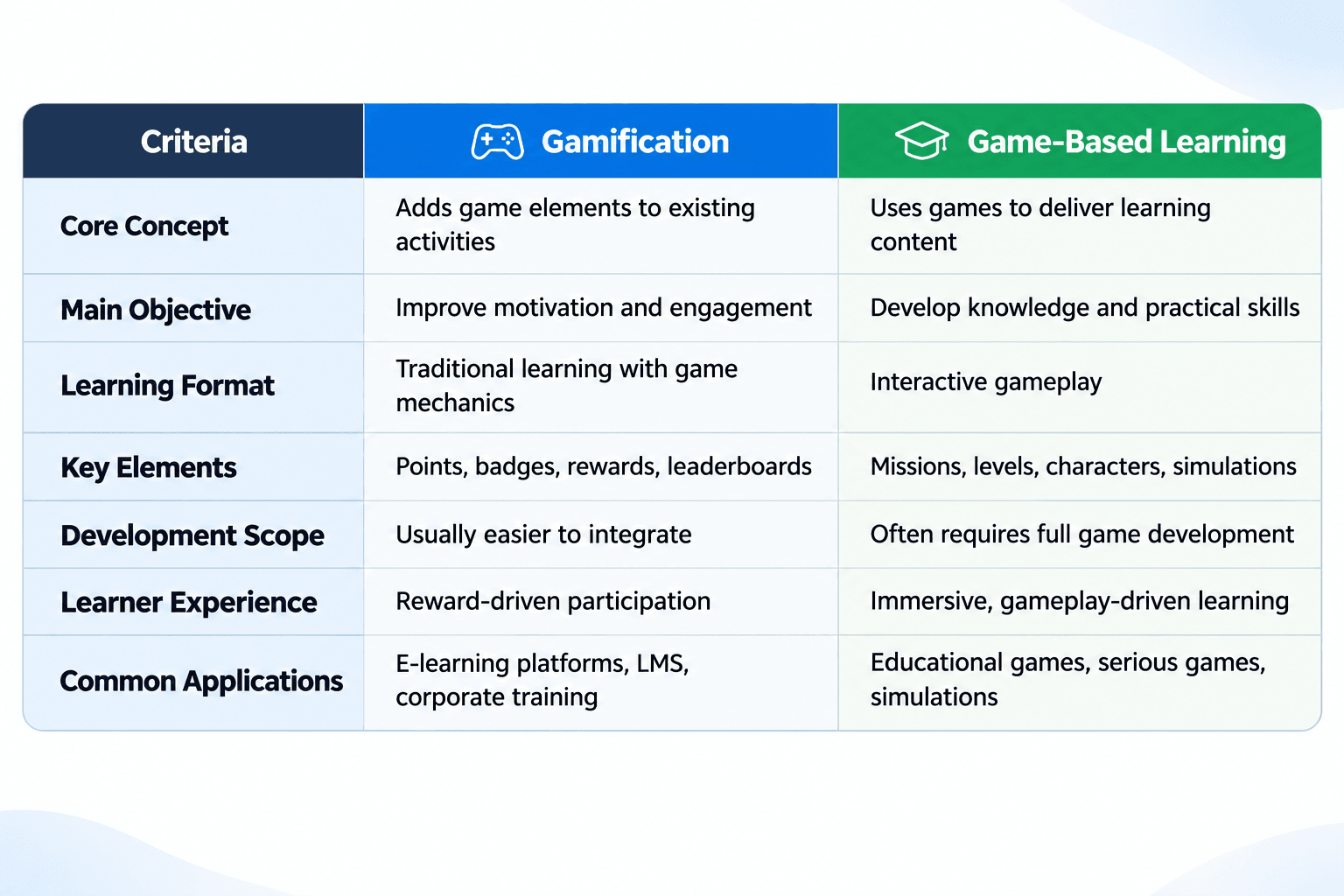
The following comparison summarizes the main differences between these two approaches.
Gamification vs Game-Based Learning: Which Approach Should You Choose?
There is no single approach that works best for every learning environment. The right choice depends on your educational objectives, target audience, available resources, and the type of experience you want to create.
When Should You Choose Gamification?
Gamification is a good choice when your goal is to increase engagement and encourage consistent participation. An EdTech company with low course completion rates, for instance, can introduce daily challenges, progress tracking, badges, and rewards to motivate learners to stay active. Businesses can also use gamification in employee onboarding, compliance training, and professional development to make learning more interactive. If you already have educational content and want to improve engagement without developing a complete game, gamification is a practical solution.
When Should You Choose Game-Based Learning?
Game-based learning is a good choice when your objectives involve interaction, problem-solving, or practical skill development. Educational institutions can use simulation games to teach complex concepts, while businesses can create scenario-based games to help employees practice decision-making in realistic situations. This approach also works well for subjects that benefit from storytelling and hands-on activities. If you want to develop an educational game, virtual simulation, or interactive training experience, game-based learning offers greater opportunities for immersive design.
How Infantex Supports Interactive Learning Development
Infantex provides Custom Game and Gamification Development ervices to help businesses turn educational content and training programs into engaging digital experiences. Check out our portfolio to see some of our work.
For organizations looking to improve user engagement, Infantex develops customized gamification systems featuring interactive challenges, progression mechanics, reward systems, and other game-inspired elements tailored to specific project requirements. Beyond gamification, Infantex also develops educational games, edutainment products, branded games, and interactive simulations. These solutions offer more immersive ways to deliver content and engage users. We provide game development, game art and UI/UX design services to support different stages of production. Each solution is tailored to the project's goals, target audience, and technical requirements.
Have an idea for an interactive learning experience? Contact Infantex to discuss your project and explore the right development approach.
Conclusion
Understanding the difference between gamification and game-based learning is essential when choosing the right approach to interactive education. Neither approach is universally better. The right solution depends on your learning objectives, target audience, and project requirements. With the right development strategy, gamification and game-based learning can turn traditional learning experiences into more interactive and meaningful digital products.
Frequently Asked Questions (FAQs)
1. Is gamification the same as game-based learning?
No. Although both approaches use game design principles, they serve different purposes. Gamification enhances existing activities with game mechanics, while game-based learning uses games as the primary medium for delivering educational content.
2. What are some examples of gamification in education?
Common examples include achievement badges, daily learning streaks, progress bars, leaderboards, reward systems, and interactive quizzes. These features encourage learners to participate regularly and complete educational activities.
3. What are some examples of game-based learning?
Examples include mathematics puzzle games, science simulation games, history-based adventure games, and business training simulations. These games allow learners to develop knowledge and skills through interactive challenges and gameplay.
4. Is game-based learning more effective than gamification?
Neither approach is automatically more effective than the other. Gamification is useful for improving participation and learning motivation, while game-based learning can provide opportunities for practical application and problem-solving. Their effectiveness depends on the learning objectives and implementation quality.
5. Can gamification and game-based learning be used together?
Yes. An educational game can integrate gamification mechanics such as points, badges, rewards, and leaderboards. This combination creates an interactive learning environment while encouraging users to stay motivated and make progress.