On-Chain vs. Off-Chain Game Architecture: How to Design the Right Web3 Game Backend
Every Web3 game has to answer one question early in development: which parts of the game live on the blockchain, and which stay on a traditional server? Get it wrong, and you end up with a game that is either too slow and expensive to enjoy or one that gives players little reason to believe they truly own anything. This guide explains the difference between on-chain and off-chain architecture, compares them on the technical points that matter most, and shows how to choose a backend design that fits your game.
Understanding On-Chain and Off-Chain Game Architecture
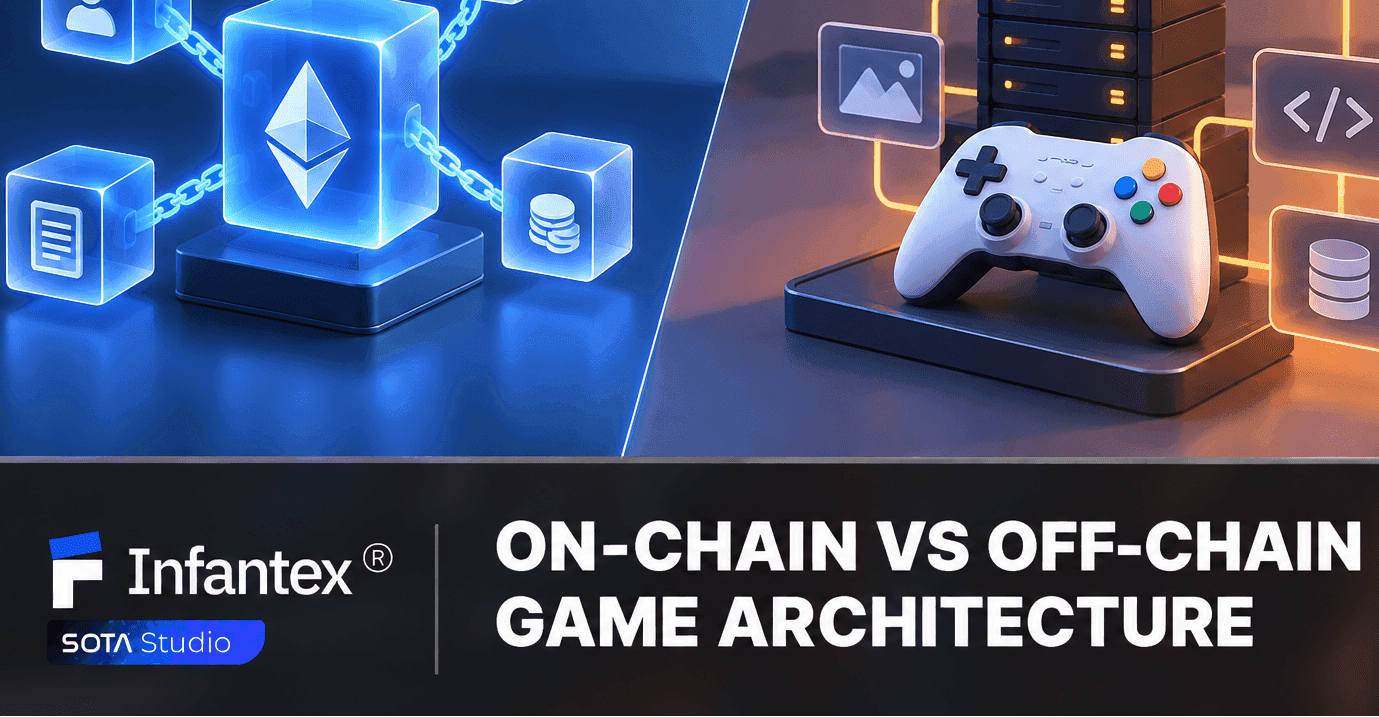
On-chain refers to data and logic that are recorded and executed on a blockchain, usually through smart contracts. Off-chain refers to everything handled outside the chain, such as game servers, databases, and application logic running on your own infrastructure. Almost every Web3 game uses both, so the real architectural decision is where the line between them sits.
What belongs on the blockchain?
The blockchain is best suited to anything that benefits from public verification, permanence, and player ownership. In a game, that usually means records of who owns which assets, such as characters, items, or land, along with the transfers and marketplace trades that move those assets between players. It also covers in-game currency balances when they carry real value, and any rules that players need to be able to verify for themselves, such as how rewards are distributed.
A useful test is to ask whether a player would care about owning or independently verifying a piece of data. If the answer is yes, it is a candidate for the chain.
What should remain in the game backend?
Everything that needs to be fast, frequent, or private is better kept in the game backend. Real-time gameplay, physics, matchmaking, session management, chat, analytics, and anti-cheat logic all fall into this group, as does player progress that has no ownership value. These systems are updated many times per second or many times per session, and forcing each update through a blockchain would make the game unplayable.
Once you know what each side is good for, the next step is to understand how they differ in practice. Three differences shape most architectural decisions: how quickly actions complete, what they cost to run, and how well the data is protected.
Latency and transaction finality
A game server can respond in milliseconds, which is what real-time gameplay depends on. A blockchain transaction, by contrast, has to be submitted to the network, included in a block, and confirmed before it can be treated as final. The time this takes varies by chain, but it is always slower than a server call, and finality is not instant. This means on-chain actions cannot sit inside the core gameplay loop. They work well for moments where a short wait is acceptable, such as claiming a reward, minting an item, or completing a trade.
Infrastructure and operating costs
On-chain operations carry transaction fees, paid either by the player or by the studio, and these costs grow with the number of actions the game sends to the chain. Smart contracts also have to be developed, tested, and audited before deployment, which adds to the upfront investment. Off-chain infrastructure has a different cost profile. Cloud servers and databases are billed according to the resources they use, and the cost scales with player numbers in a way that is far easier to forecast. Moving high-frequency actions off-chain is therefore one of the most effective ways to keep operating costs under control.
Security, transparency and data integrity
The strength of the blockchain is that its records are transparent, tamper-resistant, and open to audit by anyone. That is what gives players confidence in their ownership. The trade-off is that deployed smart contracts are difficult to change, so a bug can be costly, and public data is not suitable for anything that should stay private. An off-chain backend sits at the other end of the spectrum. The studio controls it, so problems can be fixed quickly and sensitive data can stay private, but players have to trust that the studio is managing the data honestly. The studio is also responsible for protecting its servers and databases from attack. In practice, the two sides complement each other, which is why most games combine them.
Hybrid Architecture for Web3 Games
A hybrid architecture keeps gameplay and fast-changing state off-chain while using the blockchain as the record of ownership and value. It is the most common approach for Web3 games because it gives players a smooth experience without giving up the benefits of on-chain assets. Making it work well comes down to three practical challenges: connecting the game client to the blockchain, keeping the different data layers in sync, and handling the cases where something goes wrong.
Connecting Unity or Unreal Engine to blockchain services
Game clients built in Unity or Unreal Engine can reach blockchain services in two main ways. They can connect directly through SDKs and wallet integrations, which lets players sign transactions with their own wallets, or they can route requests through a backend service that acts as a bridge between the client and the chain. Many games use a mix of both, with the wallet handling anything that requires the player's approval and the backend handling reads and everyday requests. Whichever route you choose, the game client should never need to understand the full complexity of the blockchain. A clean integration layer keeps blockchain logic out of gameplay code and makes it easier to change chains or contracts later.
Synchronizing game state, smart contracts, and databases
In a hybrid game, the same information can exist in several places at once: in smart contracts, in the game database, and in the client. Problems begin when these copies disagree, so it helps to decide up front which layer is the source of truth for each type of data. Ownership is normally governed by the smart contract, while moment-to-moment gameplay state is governed by the database. The backend then keeps the two aligned by listening for events emitted by the contracts and updating the database accordingly. This way, when a player sells an item on a marketplace, the game reflects that change without the player having to do anything.
Handling failed transactions and inconsistent state
Blockchain transactions can fail, be delayed, or be dropped, and a well-designed game expects this. Rather than assuming that a submitted transaction will succeed, the backend should treat it as pending until it is confirmed, and only then grant the related item or update the player's state. Operations should also be safe to retry, so that a repeated request does not create duplicate rewards or assets. Even with these safeguards, the database and the chain can occasionally drift apart. A reconciliation process that regularly compares the two and corrects differences gives the game a way to recover, and clear messages in the interface keep players informed while a transaction is still in progress.
How to Choose the Right Architecture for Different Game Genres
There is no single correct balance between on-chain and off-chain components. The right split depends heavily on how the game is played, and the three genres below show how the same principles lead to different designs.
Real-time multiplayer games
Real-time multiplayer games depend on speed, so the core gameplay loop has to run entirely off-chain. Movement, combat, and matchmaking cannot wait for block confirmations. The blockchain still has a role in these games, but it is limited to the moments around the match, such as recording ownership of assets, settling rewards, or handling tournament prizes.
Strategy and resource-management games
Strategy and resource-management games move at a slower pace, which gives them more room to use the blockchain. Players are generally willing to accept a short delay when they build, upgrade, or trade. Even so, resources that change very often are usually better tracked off-chain and settled on-chain at meaningful points, so that the game stays responsive and fees stay manageable.
Trading-focused and collectible games
In trading-focused and collectible games, ownership and provenance are the heart of the experience, so a larger share of the architecture belongs on-chain. Minting, transfers, and marketplace activity are all natural fits for smart contracts. The off-chain backend still matters, since it typically manages the supporting systems that make the experience usable, such as asset metadata, search, and display.
A Practical Checklist for Planning Your Web3 Game Backend
Start by identifying which game features require blockchain verification and which can run on traditional infrastructure. Then evaluate transaction frequency, acceptable latency, operating costs, and expected player activity to determine how responsibilities should be distributed.
Next, define the source of truth for each type of data and establish how smart contracts, databases, and game servers will synchronize. The architecture should also account for failed transactions, delayed events, and inconsistent records.
Finally, consider integration complexity and long-term maintenance. Planning blockchain services alongside gameplay and backend development helps reduce unnecessary complexity and supports a more reliable system.
Choosing Infantex as Your Web3 Game Development Partner
Building a reliable Web3 game backend requires expertise in game engineering, backend development, and blockchain integration. Choosing the right partner helps ensure your architecture meets your game's performance, security, and scalability requirements.
Infantex provides Web3 game development and full-cycle game development services, covering game design, engineering, and blockchain integration. With 7+ years of experience and 50+ projects delivered for global partners, we help businesses build Web3 games tailored to their technical and gameplay requirements, from real-time multiplayer experiences to strategy games and NFT-based collectibles. Contact Infantex to discuss your Web3 game development project and find the right technical approach for your game.
Conclusion
Choosing the right Web3 game architecture means balancing performance, transaction costs, security, and digital ownership. For many projects, a hybrid approach offers the flexibility to deliver smooth gameplay while leveraging blockchain for essential operations. We hope this guide helps you make informed decisions when designing your Web3 game backend.