

POST
Sep 15, 2026
End-to-End Game Development: From Concept to Live Operations
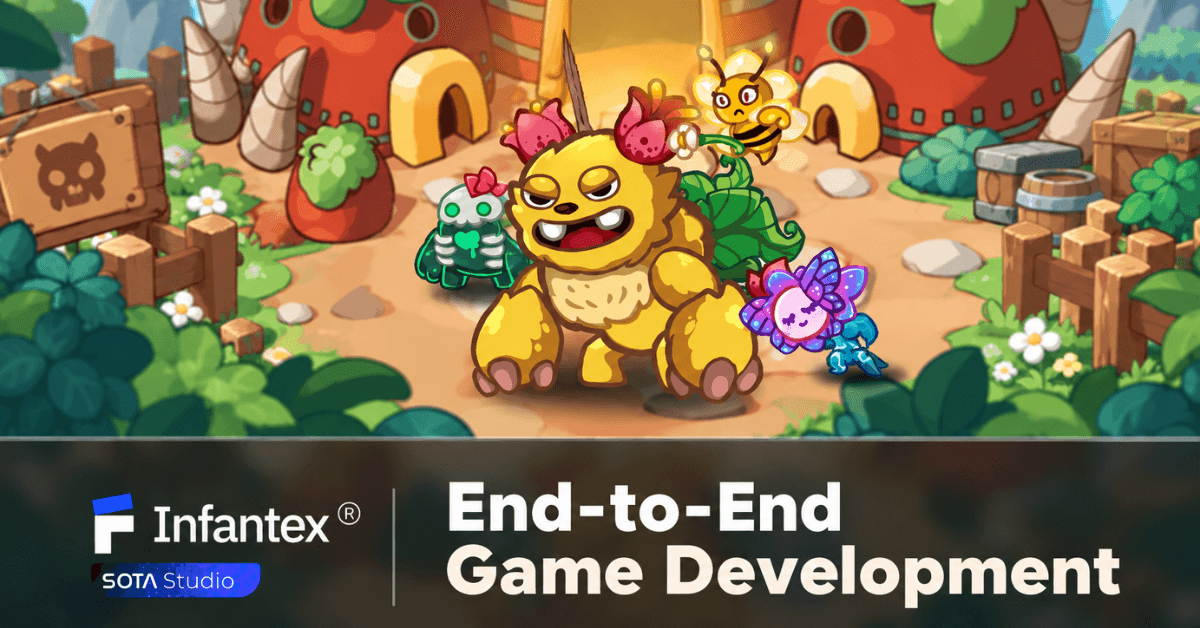
The gaming industry has evolved far beyond simply building a game and publishing it to an app store or distribution platform. Today's successful titles are the result of a carefully managed lifecycle that begins with an idea and continues long after launch through content updates, player engagement, and ongoing optimization. In this article, we'll explore each stage of the game development lifecycle, from concept validation and production to launch and LiveOps, and examine why continuity across these stages is essential for building successful games. We'll also share insights from Infantex's experience supporting game studios through end-to-end development, helping transform ideas into scalable, long-term products.
What Is End-to-End Game Development?
End-to-end game development refers to the complete process of creating, launching, and operating a game throughout its entire lifecycle. Rather than focusing solely on coding or asset production, this approach encompasses concept development, game design, engineering, quality assurance, deployment, and post-launch support. The primary advantage of this model is continuity. Decisions made during the early stages of development directly influence technical scalability, production efficiency, and long-term player retention. When teams manage the entire process holistically, they are better positioned to avoid costly rework and respond effectively to changing business requirements. This approach has become particularly important as modern games increasingly rely on backend services, live content updates, analytics, and community engagement to drive long-term success.
Building a Strong Foundation Through Concept Validation
Many game projects encounter difficulties long before development begins. A common mistake is moving directly into production based on assumptions rather than validating market demand and player expectations. Successful game development starts with understanding the target audience. Different player segments have different motivations, engagement patterns, and spending behaviors. A casual mobile game designed for short play sessions requires a fundamentally different strategy than a competitive multiplayer title or a blockchain-based game economy. Market research also plays a critical role during this phase. By analyzing competitors, industry trends, monetization models, and player feedback, studios can identify opportunities and refine their product vision before investing significant development resources. Concept validation helps answer one of the most important questions in game development: not whether a game can be built, but whether it should be built. The insights gathered during this phase establish a clear direction for the project and reduce uncertainty throughout development.
Turning Ideas Into a Production Roadmap
Once the concept has been validated, the next step is transforming high-level ideas into a structured development plan. This stage, often referred to as pre-production, serves as the bridge between vision and execution. While it may not be as visible as programming or art production, it has a significant impact on the success of the project.
Defining the Core Gameplay Experience
Before development begins, teams need to establish the systems that will shape the player experience. This includes defining gameplay mechanics, progression systems, reward structures, monetization models, and user flows. The objective is to create a cohesive framework where every feature supports the overall product vision. A well-designed foundation helps prevent scope creep and reduces the likelihood of major design changes later in development. Many studios also create prototypes during this phase. A playable prototype allows teams to test core mechanics, evaluate player engagement, and identify potential challenges before committing to full-scale production. According to Infantex's development process, prototypes often serve as a critical validation step before production resources are allocated at scale.
Planning the Technical Architecture
Technical decisions made during pre-production often have long-term consequences. Choosing the right game engine, backend infrastructure, analytics platform, and deployment strategy affects everything from development speed to post-launch scalability. Teams must consider not only current requirements but also future growth. For example, a game that plans to introduce multiplayer functionality, seasonal events, or cross-platform support must account for those requirements from the beginning. Building with future expansion in mind helps avoid expensive architectural changes later in the project.
Production: Where Vision Becomes Reality
Production is the phase where concepts, designs, and prototypes evolve into a fully functional game. This stage typically involves collaboration across multiple disciplines, including engineering, art, animation, UI/UX, audio, and quality assurance. Maintaining alignment between these teams is essential for delivering a polished and cohesive product. Modern development pipelines increasingly emphasize iterative delivery. Rather than waiting until the end of development to evaluate progress, teams work in shorter cycles that allow for continuous feedback and refinement.
Art and Engineering Must Work Together
One of the challenges many studios face is coordinating art and engineering resources efficiently. When artists, designers, and developers operate in separate workflows, production bottlenecks often emerge. By integrating these disciplines into a unified pipeline, teams can iterate more quickly and reduce communication overhead. This integrated approach is a key advantage of full-cycle development teams that maintain both art and engineering capabilities in-house. It allows visual assets, gameplay systems, and user experience improvements to evolve simultaneously rather than sequentially.
Read more: Game Art Outsourcing: The Complete Guide for Game Studios (2026)
Beyond Gameplay: Building the Systems Behind the Game
Today's games depend on much more than front-end gameplay mechanics. Player authentication, inventory management, matchmaking, analytics, leaderboards, live events, and monetization systems all require robust backend infrastructure. These systems form the foundation of modern game operations and directly impact the player experience. As games continue to adopt live-service models, scalable backend architecture becomes a critical component of long-term success. A game that performs well during testing can still encounter significant challenges if its infrastructure cannot support growth after launch.
Quality Assurance Is a Continuous Process
Many teams still view quality assurance as the final step before release. In reality, testing should be embedded throughout the entire development lifecycle. Identifying issues early reduces costs and improves overall product quality. More importantly, continuous testing helps ensure that new features do not introduce unintended problems into existing systems. Quality assurance today extends far beyond bug detection. It includes evaluating gameplay balance, user experience, device compatibility, performance optimization, and network stability. For multiplayer and live-service games, testing must also account for real-world conditions. Simulating large player populations through load testing and stress testing helps teams understand how systems will perform after launch and reduces the risk of unexpected outages.
Launching a Game Is Only the Beginning
Releasing a game is a major milestone, but it is not the end of development. Launch provides the first opportunity to observe how real players interact with the product at scale. User behavior often reveals opportunities and challenges that were not visible during internal testing. For this reason, many studios conduct soft launches before a global release. These limited-market releases allow teams to evaluate retention metrics, monetization performance, and technical stability while minimizing risk. Preparing for launch also involves operational readiness. Server infrastructure, analytics systems, monitoring tools, customer support processes, and deployment workflows must all be in place before players arrive. A successful launch depends as much on preparation as it does on development quality.
Why Live Operations Have Become Essential
The most successful games today are rarely static products. Instead, they evolve continuously through content updates, seasonal events, balance adjustments, and community engagement initiatives. This ongoing process, commonly known as LiveOps, has become one of the most important drivers of long-term player retention and revenue growth. Infantex identifies Live Operations and post-launch support as a core component of modern game development services, particularly for studios focused on long-term player engagement.
Using Data to Drive Development Decisions
Modern games generate vast amounts of player data. Retention rates, session lengths, progression patterns, conversion metrics, and feature adoption rates all provide valuable insight into player behavior. By analyzing this data, development teams can identify what is working, what is not, and where future improvements should be prioritized. Data-driven development helps reduce guesswork and enables teams to make informed decisions about content updates, monetization adjustments, and feature enhancements.
Keeping Players Engaged Over Time
Player acquisition is expensive. Retaining existing players is often far more cost-effective than continuously acquiring new ones. Regular content updates, limited-time events, community activities, and gameplay improvements help maintain engagement while extending the lifecycle of a game. Studios that invest in LiveOps are better positioned to build sustainable products rather than short-lived releases.
Why More Studios Are Choosing End-to-End Development Partners
As game development becomes increasingly complex, many studios are moving away from fragmented outsourcing models that require coordinating multiple vendors across different disciplines. Working with a single end-to-end development partner simplifies communication, reduces management overhead, and creates greater alignment between business objectives and technical execution. Instead of managing separate teams for game design, development, QA, backend engineering, and LiveOps, studios can rely on a unified workflow that supports the entire product lifecycle. Infantex provides this full-cycle approach through dedicated development teams that can support projects at any stage, whether clients need assistance with prototyping a new concept, scaling production capacity, developing multiplayer infrastructure, or maintaining live games after launch. With experience across mobile, Web3 and custom game development projects, Infantex helps studios bring products to market faster while maintaining flexibility for future growth.
Conclusion
Building a successful game requires far more than great gameplay ideas or technical execution. It requires a structured process that connects concept validation, pre-production, development, testing, launch preparation, and long-term live operations. An end-to-end game development approach helps studios align these stages into a unified lifecycle, reducing risk while creating a stronger foundation for scalability and player retention. If you're looking for a reliable game development partner, explore Infantex's game development services and discover how an end-to-end production approach can help bring your next game from concept to live operations.

MOST POPULAR




01/10
Leave a request
Send us a request today!
Share your project brief, scope and timeline. Our team will reply within 24 hours.

Services
Game DevelopmentWeb3 Game DevelopmentCustom Game and GamificationGame Art Outsourcing & UI/UX Design ServicesDedicated Game Development TeamBlockchain Development and Whitelabel ServicesContact us
- Address
- 16F, MD Complex Tower, 68 Nguyen Co Thach Street, Tu Liem District, Ha Noi Capital, Vietnam
- sale@infantex.io
© Copyright 2026 Infantex . All rights reserved.